Thursday, 20 October 2011

BVA year2 Blog 12

How film art present to wide audience


In the last few blogs, I talked about some film technics that has been frequently used in making film and the forms of expression. In this blog, I would like to explain what film art exactly is and the function of it.

Film is a new art form after literature, drama, dancing, painting, and building. Filmmaking has been developed around 200 years since it was invented at 19th century. And now it has become the most influential art in our world. There are varieties of movies, some movies are emphasize on the narrative and describing distinguished of character,some movies are more about documentary.

Due to anything could be filmed and then present to audience, so film is a comprehensive art, bearing the art factors of many arts such as moves, music, dance, drawing and literature. But different films highlight different context and genre. As a visual art student, I like the film that involved a plenty of literature factors and drawing factors.

Film absorbs the method of how literature describes human social life andthe realistic world. From the built of characters, arrange of story line, description of detail to narrative structures. However, the element of literature in film is totally different from the language art based on words. Literature can only use language art to describe and build characters. Film can express story through motion pictures, acoustics and its unique form of expression-Montage. Also, Film absorbs a lot of elements from drawing. These elements include the use of image structure, color, shadows and lines. But this is not about put drawing into filmmaking. Drawing is about reflecting human life through line and color. Film is just other way around, it using motion images and the cooperation with sound.

Film is a organic complex of many different art. It is not just piece different form of art expression together. Filmmaking is about use other art as reference and inspiration, then use these elements to create its own art form to wide audience.

BVA year2 Blog 11

Why do we transfer motion images into animation?
Nowadays, I realized that animation is no longer the show for children. It is already became an entertainment for people of all ages. Animation is stem from American and the main purpose of making animation is to entertain the general public especially children. However, with the development of techniques, animation has been wildly used in many other areas like filmmaking, commercial video and so on.”In addition to its use for entertainment, animation is considered a form of art. It is often displayed and celebrated in film festivals throughout the world. Also used for educational purposes, animation has a place in learning and instructional applications as well”.(wisegeek.com)

In my opinion, just like other forms of art, animation has its own unique attraction. Humor and exaggerations are the main elements presented by any forms of animation. Here I want to explain why people turn real life film into animation and the technique it based on.

Rotoscoping-is a method of traditional animation invented in 1915, in which animation is traced over actual footage of actors and scenery. Traditionally, the live action will be printed out frame by frame and registered.”(Wikipedia.org) So the question is why we watch the “traced” animation rather than the original film.
I think it is not wrong to watch original film, but as visual designer, it is important to think about how to display same content in more than one visions. It is interesting to look at things from different way, and consider and learn the same thing in other perspectives. Kanye West’s music video for his song “heartless”, the entire music video is a rotoscopin animation. After watching a lot of black hip-hop, rapping and gangsta music video. People might start feeling boring when looking at big size shirts, gold jewelries, sunglass and tattoo. And viewers may want to watch something new, something fresh. So, “Heartless” music video tells people what hip-hop music looks like when it is made based on animation techniques.

BVA year 2 Blog10

Analyze basic moving image editing techniques

Montage is one of the basic techniques in editing film. In contemporary film industry, montage is not just about two or more images are juxtaposed, creating meaning from the collision, montage has been divided into several technics.For creating different emotion, mood, meaning or genre, editors will use and chose the right montage technic to edit videos.

Kuleshov Effect-this is the most basic montage technic; it is just about link two scenes or images together to create third meaning. A photo of a man plus a food picture can present a concept of hungry.

Metric Montage- “this is the running time of the shot or each time of the shots.” (www.maikito.com)Commonly editors would like to use metric montage to edit documentary clips or images. That means metric montage is not a technic for editing narrative or story.

Rhythmic-“this combines elements of metric montage, the combination or collision of two shots or the rhythm of the shots. How the moment in one shot affects the moment in next shot. Here, movement takes precedence over length.” (www.maikito.com) For making music videos, rhythmic montage is the most commonly used method. In “written in the star” music video, sequences are linked based on the strong rhythm of the song. It shows how clips are affected by each other. Basically, the singer will sing the same lyrics in many different scenes. The editor’s job is to pick one or two parts from each clip and link these parts in order to produce rhythmic flow.
Tonal-tonal montage is about cutting and editing clips together that elicit emotion. The key to produce an emotion is finding the right clips to respond the tonal of background music. Another similar technic is called “overtonal montage”, this kind of editing always happen in movie trailer. Usually, the purpose of making movie trailers is to attract potential audience. So it is important to think about what is viewers feel when they finish watching movie trailer, is the emotion make them want to watch the whole movie.

BVA year2 blog 9

Political film
The question that I chose for essay assignment is about discussing if art/design has an obligation to work for political and social change. In this blog, I am going to talk about how film art reflect political issues in human being society. There is a basic concept of art from Wikipedia:“It encompasses a diverse range of human activities, creations, and modes of expression, including music, literature, film, photography, sculpture, and paintings. The meaning of art is explored in branch of philosophy known as aesthetics, whereas disciplines such as anthropology, sociology and psychology analyze its relationship with humans and generation. ”This is a pretty microscopical explanation, but it clearly tells people that no matter how artists change their art form or invent new media to create new context of art, they still cannot separate art from human life and the society they living in.

Motion image media is everywhere in modern society. And watching film has become the most commonentertainmentfor people. Many directors use film as a tool to reflect political thoughts and human social life. Therefore, except newspaper and TV shows, film already became a common media for people to realize some social issues. But the difference is- film doesn’t tell political issues directly to audience, film usually saying something deeper through narrative and art skills. For example, a comedy movie called “Burn after reading” that fully reflect the relationship between ordinary citizen’s life and high-ranking officials. I like the idea how directors use some people’s moral consciousness to link people of different kinds in society. Director uses a satirical tone to describe the bureaucratic evil practice and what the government has done for this city. Like they try to remove some state secrets through hunting good people.“If a leader sets a bad example, it will be followed by his subordinates.” In common life of average citizens there are also some secrets that they can’t tell to other people like unfaithfulness between husband and wife. However, they also use abnormal methods to settle problems.

Through watching this kind of movies, people can take the cue and enlightenment of their life. This kind of political movie tells citizens’ common life dramatically, and this can show us what our society and the environment we living in looks like or people have to be responsible for their own decisions in their life.

BVA Yr2 Blog 8

violence and sex in film

In this blog, I would like to analysis how movies can reflect historical and social phenomena and problems. There are lots of movies explore and present the disasters and social events happened in human history.In Schindler's List (1993), Steven Spielberg truly expresses the brutality of fascist in the second World War. There is a sequence can let viewers deeply feel the how serious guilt fascist made in history.


In this sequence, Spielberg uses comparison technique to explore wide difference of living environment between Nazi officer and Jewish slaves. Herr Kommandant is a high-ranking officer who controls majority of Jewish slaves. Herr Kommandant walks to the balcony and shoot at the poor slaves with worn-out clothing. What behind him are extravagant furniture and a naked woman. So the scenes of Herr Kommandant's house and Jew's are keeping crisscross.In this sequence, there are few shots are highly compared, like the haughty look of Herr Kommandant with terrified look of slaves, beautiful furniture with worn-out clothing and so on.

Different movies pursuit different objectives. Movies like Schindler's List are always describe war, race, sex, nation,faith, money, pity, encroach, hope in a serious way. However, some modern films start using new ideas and art concepts to explore same social social problems. In the movie Pulp fiction, it still includes elements like violence, money, crime, sex, race and faith. The reason why Pulp fiction is a landmark of film history is not just because its narrative structure against normal principle but also the way of how Quentin Tarantino presents the concept of violence and sex. The idea for creating this film is mixing templates of stories and narrative structures together rather than telling viewer how bad of taking drug or killing innocent people. That means there is no educational content in the film, the director just wants to let viewer easily to watch this movie like a reading fictions or novel books selling out of the streets.


Black humor is the main feature in Quentin Tarantino's work. Pulp Fiction is full of blood and thunder and its visual impact is greatly surpassed other violence movies. The quote from wikipedia tells people the violence in pulp fiction is not horrible anymore. Killing and sex are exposed in black humor."The film is known for its rich, eclectic dialogue, ironic mix of humor and violence."

All in all, violence and sex have became a common subject in Hollywood film industry. It is hard to find a Hollywood movie with no violence and sex. There are more new concepts about violence and sex like "romantic violence", "aesthetics of violence " and so on. However some people say " Hollywood's preoccupation with violence over sex has affected our ability to accurately perceive reality."(http://www.abc.net.au/) But I think to be an artist, we should think more about how to develop old ideas into something new and stop being realism unless when we have to make some political art with other purpose.

Blog 7 BVA year2


Modern Film Noir Film
It's barely to see traditional noir film nowadays but it's techniques have been using all the time. Some movies are made through film noir techniques which express the mood of dark, we call them "Neo-Noir"."Neo-Noir is a style often seen in modern motion pictures and other forms that prominently utilize elements of film noir, but with updated themes, content, style, visual elements or media that were absent in films noir of the 1940s and 1950s."(wikipedia.org)


Film noir techniques(shot angle):Sin city is a new noir film directed by Robert Rodriguez and its genre is based on Frank Miler's comic book. This new noir film is not a regular crime movies as we usually see on screen. The directors actually push the beauty of picture frame to its extreme through using a bouch of low angle shot, deep focus and bird view shot.


Low angle shot:The original reason for shot subjects in low angle is because movies are basically made on stages in the past. Viewer can't see ceiling or sky through screen."An unorthodox method used in the film was the way low-angle shots were used to display a point of view faceing upwards, thus allowing ceiling to be shown in the background of several scenes."(http://www.gradesaver.com)in/ this still, viewer can see japanese killer Miho is jumping down from the roof with two broadswords. I think the reason why the jump is shot in low camera angle is not because directors want viewer to see the sky in background but the jump in this position can give viewer more visual impact and sense of reality.


Deep focusDeep focus has been wildly using in the shot of long distance and large field scenes(depth of field). "Depth of field is the front-to-back range of focus in an image — that is, how much of it appears sharp and clear. Consequently, in deep focus the foreground, middle-ground and background are all in focus."(en.wikipedia.org)In second still, viewer can see through the lowest stairs from the top and there are a lot of cops at each stair. This kind of shot angle could also be a subjective camera position. That means camera can act as the eyes of viewer. Viewers can feel as if they are the character who is watching downstairs, a kind of feeling like "you are there".

Sunday, 25 September 2011

Year 2 Blog Assignment 6

What is "Film Noir"

In this blog, I want to talk about what is film noir and how it influenced contemporary. "Film Noir (literally 'black film or cinema') was coined by French film critics who noticed the trend of how 'dark', downbeat and black the looks and themes were of many American crime and detective films released in France to theatres following the war,"(www.filmsite.org/filmnoir.html) Film noir film use its unique techniques of light set up, shot angle to express stories about detective, crime, politics and so on. The most important thing people should learn in noir films is what techniques the filmmakers use for creating a dark, mysterious atmosphere."Strictly speaking, film noir is not a genre, but rather the mood, style, point-of-view, or tone of a film."(filmsite.org)

Main techniques:
Chiaroscuro: "in art is characterized by strong contrasts between light and dark, usually bold contrasts affecting a whole composition."(wikipedia.org)
Backlighting: "backlighting refers to the process of illuminating the subject from the back.(Low key: only one key light, a low light situation)

"The curious case of Benjamin Button"
The techniques about chiaroscuro and backlighting can be seen from some stills of this movie. The curious case of Benjamin Button" is not a noir film, but director uses a lot of film noir techniques to create atmosphere and mood which are similar to noir film. The conversation scene in Captain Mike Clark's boat is shot through chiaroscure light. In this scene, there is only one beam of light comes from window, so the light is boldly contrasting with the dark space. And it is good to see the only beam of light is on the bare belly of Captain Mike Clark, because this light makes captain a central character in this scene and it makes him the focus of this conversation.

There is a scene about a conversation between Benjamin Button and his flatmate. Benjamin sitting in front of a lamp. With this light setting, Benjamin's portrait is been illustrated from the back. That means the light source and the viewer are facing each other, with character's portrait in between, Viewer can only see the dark side of the subject, this kind picture can create a parting or sad farewell mood and atmosphere.

Year 2 Blog Assignment 5

What is Parody film

Copy and remolding has become a common technique for director to write screenplay and this kind of movies are always presented as comedy. The more formal word about this technique is parody."A parody film is a comedy that satirizes other film genres or films. Although the genre is often overlooked, parody films are commonly profitable at the box office." (http://en.wikipedia.org/wiki/Parody_film)
I can not really agree with the people who make parody movie by copy other movie's characters and genres. For example, a movie showed last year called "Vampires Suck", the idea and genre of this movie are come from vampire series "Twilight-New Moon". In "Vampires Suck", three vampire clowns replaced the three main attractive guys and girls in "Twilight". I don't like this kind of movie because they use low-taste to remold the characters which they are based on. However, if we can parody other people's work in a skillful way, the effect will be totally different.

IN 3D animation"Rango"(2011 American computer-animated Western comedy-drama film), there is a sequence that quite similar to a sequence in film "Pirates of the Caribbean: At World's End". In Pairates film, Captain Jack is trapped in a white desert. There is nothing in the desert but a ship, the ship can not take jack outside of the desert without water. Suddenly, there are millions of stone crabs come out from inside of desert and transfer Jack and his ship to the people who are looking for him.

The similar thing happened in "Rango", lizard Rango lost his town and goes to a white desert. There is nothing in the desert but a golf car.Rango swayed and fell on white ground cause he thought there is no hope anymore. After that, millions of beetles come out from inside of desert and transfer him to the place where he can get another chance to save his town. It is good to see that the director copy the scene of pirates film and remold it in a new narrative. Especially for the viewers who know the scene in pirates film, this parody sequence will give them another way to understand the genre that consisted of white desert, lost man and hope. And I think it is important for artists to express some concept in different ways.

Year 2 Blog assignment 4

How Film Montage Works In Film

Montage is one of most common filmmaking techniques that has been wildly used as a form of film editing and people can find more than one montage sequence in modern movies. There is a more accurate explanation from Wikipedia:"Montage is a technique in film editing in which a series of short shots are edited into a sequence to condense space, time, and information. It is usually used to suggest the passage of time".

In my opinion, comparing with other film editing techniques, the most unique function of montage is that montage can integrate different time, space and information into one sequence so as to produce more complex meaning or expressing main subject of film. Sergei Eisenstein is a film theorist who said that "montage is an idea that arises from the collision of independent thoughts" wherein "each sequential element is perceived not next to the other, but on top of the other" and Eisenstein also noted that"montage is the nerve of cinema".

In Schindler's List (1993), Steven Spielberg created several montage sequences in this film and the most impressive one which I think is the scene about Schindler's birthday. In this scene, Spielberg made a deranged space but with a rigorous logic. This birthday celebration scene is consisted of three sequences.The first one is Jewish wedding scene, the second sequence is about Herr Kommandant beating up his Jew woman servant and the last one is Schindler's birthday dance ball.The first sound comes out in this sequence is a song of praise in Jewish wedding, then it is converted into the music from a radio, and then it becomes the voice of singer in dance ball. When it comes to scenes, the sequence of Herr Kommandant touching his female servant Helen is keep switching with the sequences of singer touching Schindler's face; the applause in dance ball is switching with sound of beating. These scenes and sound are actually happened in different space and time, but Spielberg consists these whole lot of information organically.

Spielberg just using montage (collision of many different sequences) to describe the characters in the story and bring viewer to different space in one time. I think this is the difference between art movie and documentary.

Year 2 Blog assignment 3

What is film narrative structure

Nowadays, it is actually hard to find a movie that telling a story from beginning straight up to the ending. Each movie has its own narrative structure and the narrative techniques decides how viewers going to read the plot. There are many different forms to construct a story and the key to let viewer understand what the story of a movie is about is how to take from the multiple narrative structures for a plot.

The narrative constructions that frequently appear in modern movies are traditional narrative, Multilinear narrative, flashback narrative, cycle structure and so on. In this blog, I talk about how Quentin Tarantino constructed his Pulp Fiction。 In fact, there are more than one narrative structure in Pulp Fiction, "Pulp Fiction is structured around three distinct but interrelated story lines. Although each storyline focuses on a different series of incidents, they connect and intersect in various ways."(http://en.wikipedia.org)And the most obvious one is repetition and cycle structure.

In Pulp Fiction, there is no traditional narrative centre or a consecutive storyline but split joint of different elements.In terms of narrative structure, Tarantino abandoned traditional single storyline narrative and break the ordinary story telling rule which is based on the order of time and space. The movie starts from a rob in coffee shop but the ending is still the rob in coffee shop, so the beginning is the ending,the ending is the beginning.This hint that the multiple story lines are circularly and endlessly repeating. Tarantino telling these stories through taking them apart and rearranging them. So, viewer can see a man who already dead in front story and comes back to life later on. This makes people feel like Tarantino split the stories in pieces. There is no beginning or ending.To understand the narratives, viewers need to compose multiple narratives through using their own idea.

Anyway, the most critical point of Tarantino's idea is the recombination of fragments and various of narrative structures. There is no point to identify what the entire plot is or what the thematic the movie presents to viewers is."On another level, however, in the case of integrated multiple narratives, I will argue that cues are included within the film's structure that encourage the viewer to construct meanning from thematic or formal parallels between the multiple narratives." (http://www.euronet.nl-Defining multiple narrative structures )

Wednesday, 21 September 2011

Year2 Blog assignment 2

What is title sequence in a film:

In this week, I did some research about the title sequence in film. Usually, audience do not really care too much about the title sequence in film, people even start leaving cinema once movie is ended and title sequence appearing on screen.However, for film making and film industry,title sequence occupied an important place and it decides the quality of a film at some degree.

Why filmmakers spend a lot of money and time on designing a title sequence? And why is title sequence so important to a movie? I think title sequence is part of the entire plot of film. Because it visually and abstractively express the context of the film.This point can be seen from the movie Se7en. Seven is a psychological thriller directed by David Frncher and the title sequence in this movie influenced the whole film industry. This movie is about how a serial killer called John Doe who preaching seven deadly sins through murder seven victims. Audience can not see the John Doe's face until the end of the movie. In fact, the opening title sequence at the very beginning has already let people in the audience step into John Doe's mind. "You don't see the killer until nearly 40 minutes in, so the titles needed to bridge that gap. You're inside his head straight odd, making the tension that much more intense when he finally does show up."( Kyle Cooper-title designer of Se7en)

Elements in title sequence:
The title is not just about what type filmmaker use for presenting.Film title sequences is a collectives of background music, type design and moving image. That means people can get triple feelings which are listening, reading and watching. In Se7en, the movement of the title sequence is accurately accompanied by the musical prelude.So, the combination of type, music and moving image can let viewers feel much more than any single one of them. Also, the type is designed as hand-written style which I think is quite fit the genre that Se7en presents.

Basically, the elements of title sequence are created through the genre of film. For example, the Green hornet is a movie based on comic books. So, in the type design for the Green hornet, we can see cartoon typefaces, solid colours like yellow, green, red and blue. It is very important for film maker to think about how to connect the plot of movie with title sequence and making both of them to present same context and genre to audience.

Sunday, 14 August 2011

Year2 blog1-Being John Malkovich


Movie review and how this movie relate to art making

I begin to watch some classic movies from old time, I realized that people can learn more from some old movies and it is necessary for art students to go back and watching most primitive and purest art. Because original works are the cultural wealth that elder generation left for us. We learn them and develop them.
" Being John Malkovich " in my opinion, is the best dark comedy movie in 1999. I just seen the movie few days ago and it deeply influenced my thoughts of how I think about life. It is really hard to completely explain the entire content because the plot and structure are too complicated. But there are few scenes I really want to share with everyone. They fully reflect how bizarre and brilliant the movie is.

The first scene I would like to talk about is the puppeteer Craig. Craig is an unsuccessful puppeteer who married with a girl who is pet-obsessed. And one day he falls in love with his work partner who does not like him. There is a shot of depicting Craig's mind through a puppet show. In this scene, Craig is sadly controlling these puppets to do what he have been wanting to do. And when I looking at these puppets, it just feels like watching a tragical animation. The puppets are fully infused with life. It is quite important for artists to make their
works live. What I realize from this is that our inspiration for making art is usually come from our real life. We should observe and learn from life, and then convert life experience to artwork. I think that is how artists' works producing resonance with audience. Because most of the audience who are watching the artwork may have the similar life experience.

Secondly, I really like the few scenes where Malkovich creeps into his own head and the scene when Graig's wife and his partner jump into Malkovich's head. It is very interesting to see what Malkovich can see in his own world and what other people can see in his world. It seems like you will never know who John Malkovich really is even you step into his world. In fact, when Malkovich creeps into his mind, he actually already in his subconscious and he is looking at something that no one should see. When Graig enters Malkovich's mind
and began to control it, he actually creates a third person who is the compound body of Grai
g's art gift and John Malkovich's reputation. This can relate to our art creating process. We always relate different things together, build a new context and create a new thing which is a c
ombination of old elements.

For example, the logo of Mcdonald's. It looks simple from the appearance but it is already became party of American culture. It is just the yellow "M" letter with red background. We can see that "M" is constructed by yellow chips. Mcdonald's just using "M" and chips to create the logo which is the combination of two isolated objects.

Friday, 8 October 2010

Rechard Orjis

Question:Choose 3 terms and relate to the practice of Richard.


This week we had a wonderful lecture given by artist Richard Orjis who made some very attractive photography. I like taking pictures very much and Orjis' work inspired me a lot. Also, I realised that Orjis use other medias to present his idea or relate to his photography works. Like the performance art we saw in the video, portrait drawing by using mud as drawing materials. Orjis contained plenty of visual art elements in his work like symbolism, beauty, surface/substance, nature, juxtaposition, dream/fiction and so on. I'd like to select three elements which are strongly reflect from Orjis' work.


Nature

I think it is obvious to see that some nature facts from his work, the beautiful and colourful plants in the images are very attractive. However, it's not easy to understand why Orjis put some beautiful flowers, especially stems of Orchids in fount of a dirty body. I like the idea of how he use objects in nature to state his idea. In western country, Orchids has been known as the " most sexiest flowers on the earth". It looks like talks about the concept of the sex desire and danergous, which is not quite obvious from surface. In My Empire Of Dirt Orjis states that "Nature can be seen as beautiful and pure, and intrinsically good, but also as dangerous and destructive, a spectacle of the devourers and the devoured."(http://www.physicsroom.org.nz/gallery/2008/orjis/)


Surface/Substance


In my opinion, this term has a close relationship with Nature. I think the colourful flowers Orjis put on the human body with runny mud are so delightful and attractive. And that is about surface, the surface of nature. But the surface is not the real meaning of the work. The substance can be seen by permeate the surface of the flowers. Just like things said in the handout of Orjis' lecture" These bouquets and stems if orchids and other flowers may be a form of eye candy, but it's eye candy with a poisonous tinge"


Beauty


When I just look at those portraits with black dirt and mud, they just remind me of miner who working in coal pit and with black dirt on face every day and night. Commonly, people do not think miners could got some beauty. However, it's great to see that Orjis can let people understand that some improbable materials can also be used for present beauty. The video of Orjis' performance art could prove this point. In the gallery, many naked people with coal on the body, walking around and making some actions in an area with creepy background music. All these things could effectively make a kind of cult, culture atmosphere.


In this week, we also watched a DVD called "Manufactured Landscapes", I think the photography work Edward Burtynsky made can also reflect the point- beauty found from improbable materials. I still remember Ed Burtynsky said that he started his project by taking landscapes pictures. And the pictures about the Manufactured Landscapes are mostly taken in China. The content of those pictures are all about the labours, abandoned materials, recycled materials and scene of factory. If you look at Edward Burtynsky's photography from a long distance, you might feel that the mountains stacked by scrap iron are looked like real natural scene. However, When you look them closer, the details can remind people of the hard life of those poor labours, the circumstance made by the life commodities we throw everyday.


So, in the future, about my own practice, I'd like to try to use more materials to present the beauty which can hardly be found from the surface of the materials.

Friday, 1 October 2010

Steve Rood

Although I didn't have any class with Steve Rood before, but I already heard from other classmates that he is a photographer and a digital designer. After the show of Steve's practice, I really want to say that Steve Rood is very talented, especially the photographic works he took are really inspired me. His photography is quite uncommon from the images we usually see on fashion magazines. His photography is like a kind of making common things uncommon. And also, I can realize his attitude of how he think about the relationship between art and life.


I think to be a good photographer, Steve Rood had a good start. When he was just a kid, he already had a good consciousness of taking photo. At the beginning of the lecture, he showed us a black and white compost picture when he was a child. He said the compost was caught on fire afterwards. This event inspired him to be a photographer in the future and capture life. It is interesting to see and record the process of how a normal life object changed.


I think Steve Rood uses some traditional methods to do his photographic works as I can't find too much post production in his practices, but the contents in the works are pretty special and surprising. The first series of images Steve showed us are some shadow images. He explained that this series of images are over exposed. He also blur the intensity of an object's shadow. However, with the dark shadow and the over exposed background, we can still easily find out what the object is. I think this is a good way of how Steve focus on the most important feature of a subject, make feature stronger and weaken the unnecessary elements at the same time. This idea make me think of my own project of photography. What I made are some pictures about smoking and how smoke make people unhealthy. At that time I didn't strongly emphasized the cigarettes or the smoke come out from people's mouth and people don't understood why I took a picture of a person who is smoking.


Another series of images he showed us are quite cool I think. I especially like the one which shows some crystal liquid are running down from a green stick. People can see some liquid globules are pasted together and look like a sort of 3D pattern. In fact, what Steve Rood do is zoom in some part of an object and show people more details. I like Steve has his own way of looking life object around him and how he displays the special beautiful part of a thing in his art work. And I think artsits' job is just finding beauty from our normal life and make it unusual.

Moreover, I'm so keen on the history of photography Steve told us as well. If people of the past want to capture something, they need to use a mirror device and reflect things onto a paper, and people just drawing picture on the reflection. After that, artists will do some more detailed oil painting on the image and make it more real, looks like a real picture. With the development of camera, the mirror reflection method is sifted out gradually. However, I think each period has their own feature. Back to thousand years ago, a oil painting may not that real but the artistic value is much higher. And right now, with the development of technique, everyone has the chance taking pictures for capturing their own life.

Friday, 24 September 2010

Fran Allison - Collabration vs collective

Question:
1. Define collaboration and how it differs from a collective.
2. How have these terms influenced Fran's practice.
3. Give an example of collaborative art practice.


Fran Allison, a jeweller who introduced us some quite new terms in this week- collaboration and collective."In the last 10 years or so collaborative art practices have moved in to the mainstream of cultural production, and collaboration is now largely taken for granted as one of the numerous ways that artists can choose to operate. "(http://collabarts.org/) Actually, this is the second time that we get in touch with the term collaboration and the first time is with Dion. Interesting thing I find is, when we hear of the collaboration relate to art practice, the first things that usually come to our mind are some large projects, like Dion's public sculpture projects finished with other artists. And I didn't realise that jewellery design needs lot's of collaboration as well. In any case, collaboration has spilled over into many kinds of art practices.


Fran mentioned the difference between collaboration and collective. Collaboration is like some people who organize a group and doing a piece of work together, they share each other's ideas and give assist to the members. Once the project is finished and show to the public, people will recognized that the artwork is done by a whole group, which means that the authorship is not individual. However, collective is more like individuals who working with different projects in a same space or one studio, but the authorship of artworks still remain a personal names. Each person has their own work to do and basically their do not share ideas with other people .


Fran Allison once worked in a New Zealand jeweller group called "Weeds" with other three artists. Although the Weeds has gone, but I can still find some great jewellery productions from the Internet. It looks like the theme of these productions basically is plant, and it's easy to find some beautiful patterns on different jewellery. For Fran, Weeds is a group where she practised numerous experiments, got some experiences of doing collaboration project.


During the lecture, Fran introduced a series of collaborative and collective groups. I particularly like the group UNNATURAL, NATURALLY. This group is consisted by two artists called Lauren Simeoni and Melinda Young who are living different cites. "Melinda Young has a Master of Visual Arts from Sydney College of the Arts and is currently a full time teacher at Design Centre Enmore. Simeoni has a Bachelor of Arts (Gold and Silversmithing) from Canberra School of Art and undertook a Design Associateship at the JamFactory in Adelaide."(http://www.jewelleryandobjects.org/news/)


I think this group is quite special. It's great that although they are living in different places, but they can still cooperate very effectively. Fran said they share materials together by sending package and if I was hearing it correctly, they also using the same schedule. And their artworks involved a wide range of elements. They make a lot of artificial plant foilages by using different materials. And in my opinion, one more feature that make UNNATURAL, NATURALLY's works different from other collective group is that this two artists have two very different life background, and they working between two cities. So, I think their works can reflect two different life background of this two artists as well.

Friday, 17 September 2010

Deborah Crowe's Lecture

Blog Qustion: What is Deborah Crowe's 'one idea' made up from and how does it keep recycling in various works?

We had a lecture from Deborah Crowe this week. In the lecture, she displayed some of her own practice and some other artists' work that impacted her, gave her inspiration. Deborah is a textile designer and works are more about 3D construction and space. And what I need to emphasize is that when we look through Deborah's work, it's easy to see that some of her works are not actually designed or made of textile. But we can still find the elements of textile like textile's texture in many of her works. It's very interesting to see that she using other art forms to reflect and present textile design.

One thing I learned from Deborah is that in her working process, she usually make lot's of hand-drawing or models as planning and drafting. I think it's a important part of artwork making. A designer can not just grab some materials and start making objects without a thorough plan. In Deborah's statement" Most architectural drawings and models emphasise edges, borders and boundaries, delineating shifts from one material or component to another or from solid matter to empty space." Deborah trying to use materials that are connected and woven together, I saw some experiments include hand-drawing, models and even some graphic designs made through computer software. These are all some really nice draft plans and experiments for making a great work.

I think Deborah extended her ideas to a very broad area, and the materials she handles are wide, such as metal, digital, paper, print, sound, light and so on. For example, in her work 'shift 2000', she hang up several 3D forms around a space, the forms are included some textile design factors, like the woven lines and grids. With the lights on the top, a strong shadow can be seen on the white wall. So, in this way, viewers can enjoy the combination of real object and visional images around the contradiction environment. I think this sort of works really influenced me. Because in my own works, no matter printing or sculpture, I usually just use the materials I familiar with and I never think about try to use something else to present my idea. And I think I should try to find some other materials to work with and extend my idea broader.

I also like Deborah's body wear art works, especially the "collared1999" . They are composite of few elements-object, texture of the cover, photography and so on. These works reminded me of my own practice last semester, in the jewellery courses, what we need to do was make containers that can be touched on the body. The "collared1999", when people look at the object, it's hard to imagine that is something can be wore on the body. But when we looking at the ones with red line and grids, they are really something look like scarf or napkin.

And I think this series of containment works were impacted by an artist called Fraser Crowe. Because I can see some same elements between two artists' works. Crowe also like to make something looks like a container and contain part of human body.

From Deborah's lecture, what I been benefited most is how she come up with good idea and use various of materials to present her idea and play with the construction and space. In the future, what I exactly should do is try to work with more different materials and do more experiments for my own practice.

Friday, 27 August 2010

Steve Lovett

Blog Question: How has Steve Lovett's practice evolved over the period of his professional career, ie. from political, social/historical concerns to issues of colour and form.

I have been expecting Steve's lecture in since I saw the lecture list. Because I like Steve's class very much. To myself, I'm very keen on making 2D work instead of 3D. And Steve is the very accomplished artist who like making 2D print works. Fortunately, my first 4week studio class is with Steve. So, by having his class help me have a better understanding about the content of Steve's lecture.

Basically, most of Steve's earlier projects are interactive works, which he worked with friends and other fellows, and the things behind the collaborative works are people's personal history and story. Steve's idea is like to identity the relationship between the objects he printed and the personal story behind the objects.

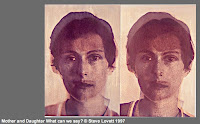
In the beginning of the lecture, Steve introduced us what is his work exactly talk about. He told us his work are concern with historical narrative and story telling which are quite personal and private. And this idea makes Steve's work very individual and creative.Obviously, in some of Steve's work, I saw lot's of portraits prints. Like the "Bamb\Darren", "Speaking Parts". And the stories behind the portrait prints can usually reflect some social issues or flexible notions of community.

I select one work from Steve's portrait prints called "Mother and Daughter What can we say?" which I consider can relate to some social issues. I like the idea of how this work speaks about notions of community and attachment. As we can clearly see that Steve uses different layers with different colours to print the female portrait. It looks like the portrait is separated from one to two. This work can make us think of how can we know ourselves through our interaction and conversation with the people around us everyday. And how can interaction and dialogues identity ourselves from other person.

Steve's work generally changed after 2000. His works are more relate to using space to present ideas. Political and historical are still the main orientation of his work. During this period, I found most of his work are more about film sequence.


For example, the "Intersection" 2007, Steve explained that "Each of the works in this show featured observation of a single location at different times of the week, looking a different usage of a single site." It is talk about the connection between time and space. At different time, the things happened in same space will be different. It is like some people individually participate in a public space, and their personal discourse then become part of the public narrative in the space.


I'm deeply inspired by Steve's lecture and his class. He taught me how to come up with a good idea and how can I push my original idea to something new. I like the way how Steve expresses his ideas in a visual form. Most of his works are in print form. And I like print because I think print work have a nobility and a humanity about them, something you can not achieve solely by computer or electronic printer. I like to see something with hand-made feeling.

Friday, 20 August 2010

Frances Hansen's Lecture Respond

Frances Hansen briefly taught us life drawing in last semester, from her classes(although I didn't know Frances Hansen's work before) I thought her artwork should be something like representing the beauty of human body or physical beauty. However, finally I found her art style is expressing life objects she collected in her everyday life and making unattractive things attractive. And by looking at her art painting, I realised this sort of art is very unfamiliar to me and I never touched materials art making before. So, Frances Hansen's art paintings widen and broaden my mind of how I thought about art.
I'm really interested in Hansen's art making process. It's including collecting, constructing, thinking and changing. Hansen showed us various objects she collected previously and told us the process of how she reworked with her collections. Put aside the art style for a moment, the first thing I was focus on are the things she painted. For instance like packaging materials, cleaning bottles, glasses and even some paintings made by her children. Secondly, there are some design elements I find from the way of how Hansen constructing those objects: The negatives/positives shapes always appear in her work which are obvious, and she also using different colours divide up the whole painting and using light colors draw objects on the background. So, viewers can feel the strong sense of decorative design.
I think this is very close to the class I had with Steve Lovett at last semester-material drawing. At that time, I did a lot of material collections, find out what materials are useful for my drawing and investigate how could those second hand objects be changed and developed. And what Frances Hansen doing is just changing her life objects and doing something surprising with them. The most important thing we should learn is not the working process, the key is how we think about our life and how we respond to our life.
There are some materials drawing artists' works that are also very similar to Hansen's work. For example, ED Ruscha, a famous American whose mode of creation is using text as objects in his paintings.
"In some works, phrases float across sunsets or pretty blue skies; in others they’re barely visible and painted on stained canvases with egg yolk. In many ways he uses words as if they were objects and even in his eerie silhouette paintings they make their presence felt."http://www.elleuk.com/culture/art
Others like Hany Armanious who like to use sculptural form to represent everyday objects. I really like the Porcelain Palace because it is a very typical life object drawing.


PORCELAIN PALACE2008Cast polyurethane on plywood8 x 16 x 2 in. (20.3 x 40.6 x 5.1 cm.)


"HANY ARMANIOUS produces installations and sculptural forms, as well as paintings and drawings that engagingly expand upon the role of the artist and the form of the artwork. He consistently surprises with his deft working and reworking of objects, materials, and references, remodeling the everyday in oddly lyrical ways." http://www.foxyproduction.com/artist/view/639
In short, Hansen's works are about developing and changing her life objects in a special way. A way that can change a normal thing to an artwork or something that could pay more people's attention. There are so many life objects that can hardly let people to notice. In fact, usually, the extraordinary thing is just come from some ordinary things. Artists' job is to discover unusual things from normal life. Anyway, Hansen's works inspire me a lot, show me how could I think up a good idea if I'm going to do a project and tell me art is come from life.

Friday, 13 August 2010

Semester2---Moving Image respond

Moving image is a kind of new art form when compared with some traditional graphic art forms. I am really interested in moving image art cause I like watching movie. No matter contemporary movies produced by Hollywood or some black and white movies produced in early time, all sort of movies attract me very much. Through listening Eidon Booth's lecture about moving image, I understood more facts about moving image making and how it made. Some terms that mentioned by Eidon Booth are very important in making moving image like montage, panning, split screen, editing and so on.
Another issue mentioned in Edion Booth's lecture is about what moving image represent. Some people might say reality, because things like TV program, movie are all acted and played by real person and events happened in movies are commonly happened in real world as well. Others would say illusion, because some of the programs are edited from fiction or some airy play. In my opinion, Moving image is talk about reality, but the reality has been edited and designed, so I think the relationship between reality and illusion is blurred. I would like to use some of the film terms to discuss Edion Booth's exploration of reality and illusion.
Split screen
One of the videos Edion showed us is a movie that divided in two frames, so viewers can watch two different screen which are talk about different things at the same time. Interestingly, this two frames actually have a connection. By this method, viewers can watch and think about the connection between the two frames. There are lots of television works using this method to represent some social reality. Once I saw a TV program, the screen is divided into three frames. first one is a man illicit intercourse with a beautiful girl on the bed. Second one is the man's wife is doing housework for her husband. The third is the girl's boyfriend is buying red roses for her. The three events are happen at the same time, viewers can watch them and think about more social problems.
Panning
I think panning is a movie style which is more close to our live. Panning is not always happened in old movie. Panning is just like holding a camera we brought and taking video for our friends or record our daily life. And when we project the video we made through camera, we will find the screen is keep shaking. However, this kind of method had been used in Hollywood's film making.Cloverfield, a 2008 American monster movie directed by Matt Reeves. The whole movie just like a video recorded by a war journalist. It's like a person who recorded the whole real disaster happened in New York. It seems like panning is a sort of visual impact that can make people feel something more real.
Montage
I still remember Edion once said we create a reality in the screen and the reality we create can help people understand the reality in the real world. To make this thing happen, montage is a great skill to use.
" Montage is a technique in film editing in which a series of short shots are edited into a sequence to condense space, time, and information. It is usually used to suggest the passage of time, rather than to create symbolic meaning as it does in Soviet montage theory."http://en.wikipedia.org/wiki/Montage_(filmmaking)
Nowadays, the montage is integrate into most of the big budget film productions. This technology is so common in the contemporary film. Each frame's field of view, angles, length and the combination of the frame and audio have montage element. It is observed that the montage has been used while the film started. In the final analysis, montage is way how director talk about a story to audience. Director just use some of the frames which seems illusional to make a real story with full of appeal.

Friday, 6 August 2010

Dion Hitchens- Interaction and collaboration

In this week, Dion Hitchens made a lecture about his sculpture practice. Through watching lots of his sculpture practice I found the works look quite bizarre and much more different from traditional sculpture. I have never done or participated in making sculpture. And to me, the concept of 3D objection is fuzzy. However, as a green hand in sculpture, what I strongly realized in Dion Hitchens' practice is culture and that is what Dion always mentioned in his lecture. Also, another element in his practice which strongly impressed me and made me understood more about sculpture is site.
First I would like to explore culture relating to Dion's work because I think the element culture is incisively and vividly reflected. By looking at his art work, most of them are built as public art projects. This point make me think how hard to making project for public. Making object for public is not as easy as for private. There are so many issues to consider, like a fund, time slicing, materials, technical support. All these things may narrow a designer's idea. Most importantly, a public art object people making must be accepted by the public of an specific area. Culture refection is a good method for designer to think about cause it can effectively accepted and confirmed by public. So, it's fantastic to see lots of Maori culture elements in Dion's art making.
For example, Matariki Star Waka sculpture, made by Dion Hitchens and Charles Koroneho. It is a Maori culture based work and viewer can see various elements related to Maori culture. The most obvious decorations on the Matariki Star Waka are the constellations which are linked by lines that help define different shapes. And when sky becomes dark, these flashy constellations look magnificent. At the beginning, I'm not very familiar with Maori culture and I don't know what are these constellations symbolizing . So, by searching what is Matariki from the Internet I understand Maori worshiping star image, because Maori think star image decide time, ship's position and the harvest of future years.
“They were transformed into objects of remembrance, marking places of historic or spiritual importance where the community gathered to conduct ceremonies, tell stories and share knowledge,” Charles Koroneho said. “This seemed a very fitting theme for a community building and library named Matariki.”
Obviously, from what Charles Koroneho said, Matariki Star Waka sculpture is something that directly and successfully related to the Maori culture.
Another important element I can strongly feel from Dion's sculpture is the site. It's also a knotty problem to deal with. It's really hard to decide where to put a huge scale sculpture at. For a public artwork, outside of street is just a show room in a gallery. Because a site for a artwork is significant. Just like our tutors' saying" a good display can make your work better and a bad display can kill it." I really like the site of Dion's Kotuku, like two iron birds are flying in the sky. The two iron birds are tied on the upside of that area by several thin gage wires(I guess) looks like a symbol of that place, people can see this sculpture from a long distance. Also, the position of the two birds is interesting to see, both of them goes to a negative direction and this should be a balance for site.